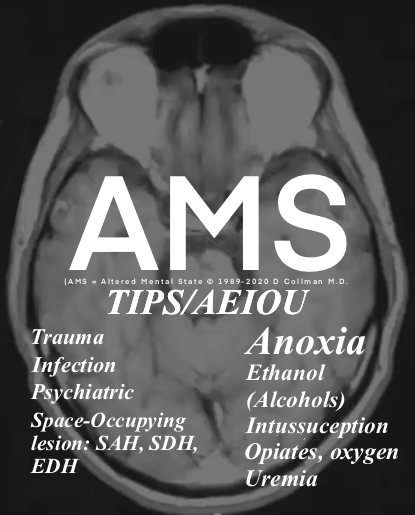
Altered Mental State [AMS]
D. Collman, M.D.
Consciousness is intricately tied to the dynamic interplay between the reticular activating system [RAS] and the cerebral cortex. The RAS governs the general state of alertness and wakefulness, while the cerebral cortex manages higher cognitive functions. Dysfunction in either or both these systems can lead to a spectrum of altered mental states, from drowsiness to coma. This clinical presentation necessitates a nuanced approach to understanding and communicating the patient’s responsiveness and arousal levels.
Clinical Presentation:
Patients with altered mental status manifest along a continuum, from drowsiness to deep coma. The spectrum includes states of lethargy, obtundation, and stupor. The language used in clinical descriptions aims for precision, employing a patient’s response to stimuli for clarity in communication. Additional nuanced states, such as the minimally conscious state and locked-in syndrome, underscore the complexity of altered consciousness, requiring careful consideration in assessment.
Pathophysiologic Causes:
The pathophysiologic underpinnings of coma range from cellular dysfunction to overt structural abnormalities in the brain. Causes may include traumatic injuries, vascular events, metabolic disturbances, organ system failures, environmental toxins, and external insults. Recognition of the cellular or structural level of impairment aids in understanding the presentation, allowing for a comprehensive approach to diagnosis.
Differential Diagnosis:
This requires a thorough examination and medical history in the emergency department. Employing a mnemonic like TIPS/AEIOU can guide the assessment, addressing potential causes such as toxic ingestions, metabolic derangements, and structural pathologies. This systematic approach is vital for timely and accurate identification of the underlying etiology in patients with altered mental status.
TIPS/AEIOU in detail:
T: Trauma (including polytrauma & TBI), Toxins (including ingestions or exposures that could lead to AMS). Examples: medications, recreational drugs, or environmental toxins.
I: Infection (Ex’s: meningitis, encephalitis, and sepsis).
P: Psychiatric illness may manifest as AMS: depression, anxiety, or Psychosis.
S: Space-occupying lesion (SAH, SDH, EDH, i.e., consider all forms of intracranial hemorrhage), Stroke, and Seizure (latter have various etiologies).
A: Anoxia (Anoxic encephalopathy after CPR), Acidosis, and other Acute metabolic disturbance (e.g., DKA or severe electrolyte imbalances, e.g., hypercalcemia, hypernatremia, hypermagnesmia).
E: Ethanol (include toxic alcohols: methanol/ethylene glycol), Endocrine disorder: thyroid disorders (myxedema, thyroid storm) or adrenal insufficiency.
I: Insulin (and other etiologies of hypoglycemia or severe hyperglycemia-HHS), Intussusception (latter leads to LA, pain (persistent irritability), and sepsis.
O: Opiates-Investigate the use or OD of opioid medications or substances (Administer naloxone).
U: Uremia (Assess for renal failure and associated elevated BUN/Cr levels).
Legend: LA = lactic acidosis; HHS = hyperglycemic hyperosmolar syndrome.
Published by DrC
Clinical Emergency Physician
Prior Faculty for Midwestern University
EM Author/Educator/Medical Ilustrator
Expertise: EM Pathophysiology and physiology [both pediatric/adult]
Designer of a silicone membrane ECMO [extracorporeal membrane oxygenator]
By 2005 trained ⅓ of the world’s EPs for EM board certification
Trained Oral Examiners for a decade: the Board of Certification in Emergency Medicine [5000 original members...now the second largest EM group in the United States]; he was a compensated consultant for that and numerous other emergency medicine organizations.
All of Dr Collman’s presentations have been Co-sponsored AMA/ACEP category 1 CME ACCME accreditation through the AAPS, National and The Fl Chapter of ACEP and The Fl Medical Association since 1989.
Publisher of numerous EM manuals, and educational materials [all items were have copyrighted notices and have been sold by the ACEP Bookstore]; all authored by Dr Collman: 2 Vol program syllabus of thousands of Q/As and pathophysiology discussions of all chapters from eds 3-8 of “The Study Guide” [All chapters of the core content knowledge for completion of an emergency medicine residency]; teachs Resususcitation, CV Emergencies, Pulmonary Emergencies, The EKG lab [the 60 most important EKGs/management; Truama Emergencies, Pain Mgmt, Orthopedic Emergencies, Toxicology [Toxins and Antidotes, HEENT Emergies, Environmental Emergencies, Pediatric Emergencies [500 Q/As], HIV/AIDs-Infectious Diseases, Emergencies, Rhematologic Emergencies, Neurologic Emergencies, Acid-Base/ABG Presentation, Dermatological Emergencies, CT/POCUS [point of care ultrasound], Bariatric Emergencies, Endocrine Emergencies.
Dr Collman is endorsed by his programs participants [12,000+]
Examples: Dr James SULLIVAN MD DABEM; and others program participants described Dr Collman as a “National Treasure”
Dr Collman grandfathered into EM after completing a rotating Gen Surg Internship at UCLA School of Medicine [June 1981].
He accepted a directorship position at age 25, the contract to Illustrate “Emergency Management of Pediatric Trauma” [author:Thom Mayor MD FACEP] published by WB Saunders
Dr Collman provides strong intellectual support to his program attendees...many chose him to be their permanent career mentor and return annually to his live interactive conferences.
Dr Collman has designed computer-based programming to numerous organizations in ACLS algorithms [Univ of Pisstburgh]
He provides Interactive grand rounds as Case Simulations by invitation:
He designed an 8-h Visual Stimuli Presentation for Johns Hopkins Dept of EM [their board prep program;a second 8 hr presentation “The Genitourinary System-a Comprehensive 8-hour Review”; he teaches each program Johns Hopkins University.
He trained Examiners for the BCEM [AAPS] Atlanta GA: presented a combined certification review [both certification part I/orals] numerous time in Atlanta, Hawaii, Lake Tahoe, and Orlando, Fl 1991-1996.
He created their entire bard exam [part I and Oral Examination and a computer-operated Visual Examination [2 Versions] in 1996. This included 700 certification test items and 25 Oral Examination Live Test Simulations as well as trained their AAPS [BCEM Examiners twice a year for 10 years [throughout the 1990s]
Texts Authored Editor in Chief 4th-7th Ed of: “Pearls of Wisdom in Emergency Medicine [7 eds] and 35 Cds [33 are critical analysis of the 52 OBT Live CD set: audio recording made Live at Conference [cost $1515.00 (Oral Board Case studies)+ ASA/APAP toxicology CDs [each is 1 hour w/manual purchase price $65.00 for each + “CT Video: CT for the Emergency Physician”. Videotaped Live in Boca Raton, FL by Pear Productions
Publication Study Quote: “Dwight Collman MD DABEM DABFM Provides the most rigorous CME Education”...documented by EM News and EMRA [in 2002 ranked Dr Collman’s EM 8-Day Interactive Review! with the top 8 University or top ACEP chapter programs [an independent study they published for all of America’s Emergency Medicine Residents preparing for their board certification examinations.
2009 Jan Issue EM News Editor-in-chief ranked Dr Collman as the “premier educator for board preparation in the US”
Core Competencies:
Bedside Clinical Instructor all EM Medicine Clinical assessment/training EPs in all EM Procedures [over 90 procedures]
Core competency: illustrates human Anatomy as it pertains to EM/EM procedures [he does this Live and his clients request to keep his illustrations]
Dr Collman edited Emergency Management of Pediatric Trauma [while he illustrated this First-Ever Text devoted to Pediatric Trauma; he spent 2 years creating the illustrations for this text 1983-1985 and they were reproduced and resold by the publisher and appear in the Pediatric Trauma Capter of The Text: The Clinical Practice of Emergency Medicine” Ed 1., author Ann Lattimer-Harwood-Nuss [now Professor Emeritus, retired].
Completed a Fellowship in Gen Anesthesia: University of Utah School of Medicine
Awarded 5 specialty rotations [mentorship programs in medical school:ICU
President: Collman Institute Inc [a Fl S-Corp] 1994-2007 .
Clinical practice x ~40 Yrs
ABEM certification
Life Fellow Am Board of Forensic Examiners
Trains EPs in triage/emergency Pt care/documentation to mitigate litigation risk
Has been awarded teaching contracts from over 400 US Hospitals
Trains EPs from every branch of the US Military since 1989 -first group included the CO of the Portsmouth, Va Naval residency [Michael Gonzalez MD FACEP who officially made the Oral Board Tutorial! As mandatory education to graduate his residency program in 1989.
I am a “trainer-educator, author, medical Illustrator”.
I have treated college students at no cost since the 1990s
Additional skills/competencies: Documentation [chart review consultatnt], Test item Writer [wrote the entire certification partI/part II examinations in 1996
Teach/train using interactivity/I teach the statistical/mathematical precognitive approach to physicians for pediatric IV fluid protocols for resuscitation, 3 forms of dehydration, burn fluid calculations + formula for airway [pulmonary burns] 52 simulations in 5 days; the role of the CANs/EXRs; I have a program syllabus for both of my CME programs
Program author/presenter: “The Clinical Documentation Of the Emergency Medicine Hospital Chart”, a 2-Day program conducted in Park City, Utah [1992]
As a Forensic Examiner he has reviewed and consulted emergency Physician defendants [approx 30 cases over 25 years]
View more posts
 EMedNation.com